
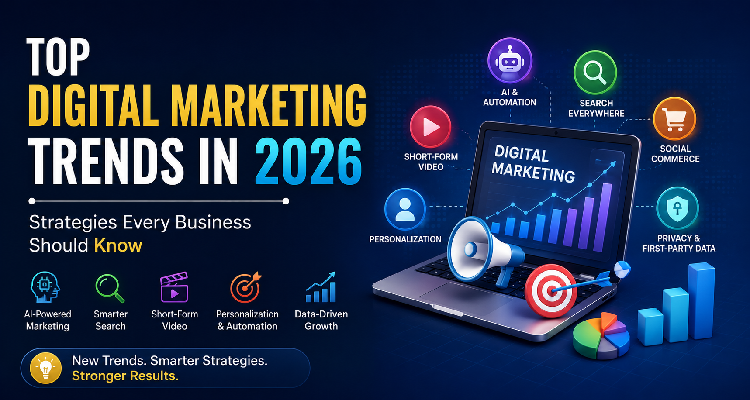
Digital marketing continues to evolve rapidly, and 2026 is shaping up to be a major year for businesses that want to compete online. Search behavior is changing, artificial intelligence is becoming part of everyday marketing workflows, and customers increasingly expect personalized experiences.
For businesses of every size, keeping up with these changes is no longer optional. The right digital marketing strategy can improve brand visibility, attract qualified visitors, generate leads, and build long-term customer relationships.
In this guide, we explore the most important digital marketing trends in 2026 and practical strategies businesses can use to stay competitive.
1. AI-Powered Digital Marketing
Artificial intelligence is becoming an important part of modern marketing. Businesses can use AI to analyze customer behavior, identify content opportunities, automate repetitive tasks, and generate ideas.
However, successful marketers should not rely entirely on automatically generated content. Original insights, experience, accurate information, and a clear brand voice remain important.
Businesses can use AI to support:
- Content research and brainstorming
- Customer segmentation
- Marketing automation
- Data analysis
- Ad optimization
- Personalized recommendations
- Customer service
The strongest approach is to combine AI efficiency with human creativity and expertise.
2. Search Is Becoming More Conversational
People are changing the way they search for information. Instead of typing short keywords, users increasingly ask detailed questions using natural language.
This makes conversational and question-based content particularly valuable.
Instead of targeting only a keyword such as “digital marketing services,” businesses can also create content around searches such as:
- How can a small business improve its online marketing?
- What are the best digital marketing strategies for local businesses?
- How can AI improve a digital marketing campaign?
Creating helpful content that directly answers these questions can make a website more useful to both users and search engines.
3. Search Everywhere: Beyond Traditional Search Engines
Consumers don’t discover businesses only through traditional search engines. Social platforms, video websites, marketplaces, maps, online communities, and AI-powered search experiences can all influence purchasing decisions.
Businesses should therefore think beyond traditional SEO.
A strong visibility strategy can include:
Website SEO + Social Media + Video + Local Search + Digital PR + Useful Content
The goal is to make your brand discoverable wherever potential customers are researching products and services.
4. Short-Form Video Marketing
Short-form video remains one of the most powerful formats for attracting attention online.
Platforms such as TikTok, Instagram Reels, and YouTube Shorts allow brands to communicate ideas quickly and creatively.
Businesses can create videos around:
- Product demonstrations
- Customer questions
- Industry tips
- Behind-the-scenes content
- Tutorials
- Case studies
- Frequently asked questions
You don’t always need expensive equipment. A clear message, strong opening, useful information, and consistent publishing schedule can make a significant difference.
5. Personalization Becomes More Important
Customers don’t want to feel like anonymous visitors. They expect brands to understand their interests and provide relevant experiences.
Personalization can include customized email campaigns, product recommendations, location-based offers, and content based on previous interactions.
For example, an ecommerce website could recommend products based on browsing behavior, while a B2B company could send different content to first-time visitors and returning leads.
The key is to use customer data responsibly and provide genuine value rather than simply increasing the number of promotional messages.
6. Local SEO for Small Businesses
Local search remains essential for businesses that serve specific geographic areas.
A restaurant, builder, dentist, plumber, retailer, or marketing agency needs to be visible when potential customers search for services nearby.
An effective local SEO strategy should focus on:
- Maintaining accurate business information
- Creating location-specific website content
- Building genuine customer reviews
- Optimizing business profiles
- Creating useful local content
- Earning relevant local backlinks
For example, instead of publishing a generic page about “SEO services,” a company could create useful content around “digital marketing services for small businesses in [city].”
7. First-Party Data and Privacy-Focused Marketing
Privacy is becoming an increasingly important part of digital marketing.
Businesses should build stronger direct relationships with customers rather than depending entirely on third-party platforms.
Email subscriptions, customer accounts, surveys, loyalty programs, and direct interactions can help businesses develop useful first-party data.
A quality email list, for example, gives a business a direct communication channel that isn’t completely dependent on changes to social media algorithms.
8. Content Quality Over Content Quantity
Publishing hundreds of low-value articles is not a sustainable marketing strategy.
In 2026, businesses should focus on creating fewer but more useful pieces of content.
High-quality content should:
- Answer real customer questions
- Provide original insights
- Include practical examples
- Be easy to understand
- Demonstrate expertise
- Be regularly updated
- Have a clear purpose
A detailed guide that solves a customer’s problem can be more valuable than dozens of short articles written only to target keywords.
9. Social Commerce Will Continue Growing
Social media is increasingly becoming part of the buying journey.
Consumers can discover a product, watch a demonstration, read comments, visit a brand profile, and make a purchase without leaving the platform or with only a few additional steps.
Businesses should optimize social content for both engagement and conversion.
Useful tactics include product demonstrations, creator partnerships, customer testimonials, educational videos, and compelling visual content.
10. Marketing Automation Saves Time
Automation allows businesses to manage repetitive marketing activities more efficiently.
Automated workflows can be used for:
- Welcome emails
- Lead nurturing
- Abandoned-cart reminders
- Customer follow-ups
- Appointment reminders
- Social media scheduling
- Reporting
Automation should not make marketing feel robotic. The best campaigns combine automation with relevant and personalized communication.
11. Influencer Marketing Is Becoming More Specialized
Influencer marketing is moving beyond celebrity endorsements.
Micro-influencers and niche creators can provide access to highly relevant communities. Their audiences may be smaller, but engagement and trust can be valuable for certain products and industries.
Businesses should select creators based on audience relevance, credibility, engagement quality, and brand alignment rather than follower count alone.
12. Data-Driven Marketing Decisions
Successful digital marketing requires measurement.
Businesses should monitor metrics that connect marketing activity with business outcomes, including:
Website traffic
Leads
Conversion rate
Customer acquisition cost
Return on advertising spend
Email engagement
Customer lifetime value
Organic search performance
The objective isn’t to collect as many numbers as possible. It is to understand which activities actually contribute to growth.
How Businesses Can Prepare for Digital Marketing in 2026
Following every trend isn’t necessary. Instead, businesses should build a strong foundation and adopt technologies and channels that match their audience.
A practical strategy could look like this:
Step 1: Understand your target customer.
Step 2: Identify the channels where your audience spends time.
Step 3: Create useful, original content.
Step 4: Optimize your website for search and conversions.
Step 5: Experiment with AI and automation.
Step 6: Build an email or customer database.
Step 7: Use video and social media to expand reach.
Step 8: Track meaningful business metrics.
Step 9: Test different campaigns.
Step 10: Improve your strategy based on real results.
Final Thoughts
Digital marketing in 2026 is about more than simply ranking on Google or posting regularly on social media. Businesses need to create useful experiences across search, websites, social platforms, email, video, and emerging AI-powered channels.
The biggest opportunity is not to chase every new trend. It is to understand which trends can genuinely help your audience and then use them consistently.
Businesses that combine quality content, SEO, AI, personalization, video, social media, automation, and data-driven decision-making can build a stronger digital presence and create sustainable online growth.
