
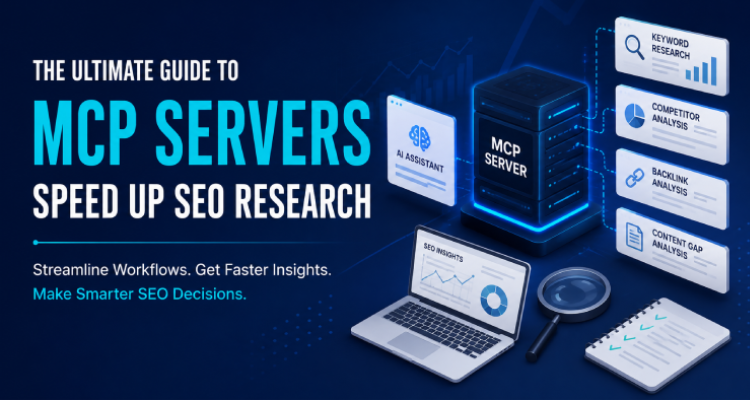
SEO research has traditionally involved jumping between keyword tools, competitor reports, SERP platforms, spreadsheets, website crawlers, and analytics dashboards. While these tools provide valuable data, the process can become slow and repetitive.
Model Context Protocol (MCP) is changing the way marketers can work with these tools. By connecting AI assistants with external applications and trusted data sources, MCP can help SEO professionals perform complex research through natural-language instructions and repeatable workflows.
What Is an MCP Server?
Model Context Protocol is an open standard designed to allow AI applications to communicate with external tools and data sources.
For SEO professionals, this means an AI assistant can potentially work directly with information from keyword research platforms, SEO auditing tools, SERP databases, competitor-analysis systems, and other marketing resources.
Instead of asking an AI to guess search volume or keyword difficulty, an MCP-connected workflow can retrieve information from an actual SEO platform.
This creates an important distinction: AI can help interpret and organize SEO data while the connected tool supplies the underlying data.
Why MCP Matters for SEO
Traditional SEO research often requires several manual steps:
1. Open an SEO platform.
2. Enter a keyword or domain.
3. Export the results.
4. Filter the data.
5. Organize keywords into groups.
6. Compare competitors.
7. Build a report.
8. Repeat the process for another project.
MCP can bring many of these steps into an AI-assisted workflow.
An SEO specialist can describe the desired outcome, and the connected tools can help retrieve, analyze, classify, and organize the information.
The biggest advantage is not simply automation. It is the ability to combine **AI reasoning with reliable SEO datasets**.
MCP vs. Traditional SEO Tools
MCP does not necessarily replace your existing SEO platforms.
Instead, think of it as a bridge between your AI assistant and the tools you already use.
For example:
Traditional workflow
SEO tool → Export data → Spreadsheet → Manual analysis → Report
MCP-assisted workflow:
AI assistant → MCP connection → SEO platform → Data analysis → Structured output
This approach can reduce repetitive work and allow SEO professionals to spend more time making strategic decisions.
1. Speed Up Keyword Research
Keyword research is one of the clearest applications for MCP.
Rather than manually searching hundreds of keyword variations, you can provide the AI with examples and rules for the type of keywords you want.
For example, an SEO marketer could request keywords related to:
- High-paying jobs
- Professional services
- Local searches
- Product categories
- Industry-specific queries
The AI can then use the connected keyword research platform to identify relevant variations and organize them into meaningful groups.
Why keyword grouping matters
A large keyword spreadsheet isn’t always useful.
Grouping keywords according to search intent, topic, location, product type, or profession can make the information much easier to act on.
For example, instead of having hundreds of individual keywords, you could create groups such as:
- Nursing
- Retail
- Sales
- Security
- Marketing
- Healthcare
This gives marketers a clearer picture of where demand exists and which topics deserve dedicated content.
2. Automate Competitor Research
Competitor analysis can also benefit from MCP-powered workflows.
Imagine asking an AI assistant to compare several competitors and identify:
- Their strongest organic keywords
- Important landing pages
- Content gaps
- Ranking opportunities
- Search visibility
- Common topics
- Areas where your website is underperforming
Rather than manually opening multiple reports, an AI-assisted workflow can organize the information into a single analysis.
This is particularly useful for agencies managing multiple clients because repetitive competitor research can consume hours every month.
3. Analyze Historical SEO Data
SEO is not only about what is happening today.
Historical data can reveal how search visibility changes over time.
With access to historical SEO datasets, marketers can investigate trends such as:
- Changes in ranking positions
- Growth or decline in keyword visibility
- Search-volume trends
- SERP feature changes
- Competitor movements
- Changes in AI search visibility
You can then turn this information into charts and reports that are easier for clients and internal teams to understand.
For example, instead of simply saying that AI-generated search features are appearing more frequently, you could analyze a tracked keyword set over several months and visualize the change.
4. Investigate SERPs at Scale
Search engine results pages can vary according to country, city, device, query, and search intent.
Checking all of these variations manually is difficult.
MCP-connected SEO tools can make large-scale SERP research more practical.
A marketer could investigate a specific query across different locations and ask the AI to identify patterns in:
- Organic results
- AI search features
- Local results
- Shopping results
- Featured content
- Competitor visibility
This can be especially valuable for international SEO and local SEO campaigns.
5. Combine Multiple SEO Tools
One of MCP’s most interesting advantages is the possibility of connecting multiple tools to an AI workflow.
For example:
Keyword research tool → Find relevant search terms
SERP data tool → Analyze search results
Site crawler → Examine technical issues
Competitor platform → Study competing domains
AI assistant → Combine and interpret the findings
This creates a more connected research environment instead of forcing marketers to analyze each dataset independently.
6. Use Better Prompts for Better SEO Research
MCP doesn’t eliminate the need for good instructions.
The quality of the output depends heavily on how clearly the task is described.
A strong SEO prompt should specify:
- The SEO tool or MCP server to use
- Country or target location
- Keyword/topic
- Minimum search volume
- Desired filters
- Grouping requirements
- Output format
- Competitors or domains
- Date range when historical data is required
For example: Use the connected keyword research platform to find relevant keywords around “digital marketing services” in the UK. Group similar keywords by search intent and return the groups with their combined search volume.
The more specific the request, the easier it becomes for the AI to produce useful results.
MCP Can Make SEO Teams More Efficient
The real value of MCP is workflow efficiency.
SEO professionals still need to decide:
- Which keywords matter?
- Which competitors should be analyzed?
- Which pages should be created?
- Which technical problems deserve priority?
- Which opportunities are commercially valuable?
AI and MCP can help collect and organize the information, but strategic judgment remains essential.
This means SEO teams can potentially move from **data collection to decision-making much faster**.
Don’t Automate Everything
MCP is powerful, but it shouldn’t automatically become the solution for every SEO task.
Some simple jobs can be completed more efficiently with:
- A spreadsheet
- A short Python script
- Google Sheets
- A traditional SEO platform
- A simple API integration
MCP can introduce additional API usage, token consumption, setup requirements, and processing time.
Before building an elaborate AI workflow, ask a simple question:
**Will MCP save enough time or provide enough additional insight to justify the complexity?**
If the answer is no, use the simpler solution.
Security and Data Considerations
Businesses should also consider security before connecting external tools to AI systems.
Before installing an MCP server, check:
- Who developed it
- What permissions it requests
- What information it can access
- Where data is processed
- How authentication works
- Whether the integration is officially supported
- What happens to stored credentials
For company environments, IT and security teams should review integrations before they are deployed across an organization.
The Future of AI-Powered SEO Research
SEO is moving toward increasingly integrated workflows.
Instead of manually moving data between platforms, marketers can use AI as an interface for interacting with multiple specialized tools.
MCP provides an important piece of this ecosystem by creating a standardized way for AI applications to interact with external tools and data.
The result could be faster keyword research, more scalable competitor analysis, better reporting, and more automated SEO workflows.
But the goal shouldn’t be to automate SEO simply for the sake of automation.
The real goal is to reduce repetitive work so marketers can spend more time on strategy, creativity, analysis, and business growth.
Final Thoughts
MCP servers offer SEO professionals a new way to connect AI assistants with the data and tools they already depend on.
From keyword clustering and competitor research to SERP analysis and historical reporting, MCP-powered workflows can reduce manual effort and accelerate research.
The best approach is to start small. Choose one repetitive SEO task, connect the appropriate tool, create a clear prompt, evaluate the results, and improve the workflow over time.
As AI continues becoming part of everyday SEO operations, MCP could become an important bridge between intelligent assistants and the specialized data that marketers need to make better decisions.
