Artificial intelligence is becoming increasingly useful in digital advertising. AI tools can analyze campaigns, identify opportunities, recommend changes and even automate parts of PPC management.
But when AI is connected to a live advertising account, the risks become much more serious. A wrong recommendation is one thing; an incorrect automated change to budgets, bids or campaigns can directly affect business revenue.
The answer is not necessarily to avoid AI. Instead, advertisers need to build safeguards around it.
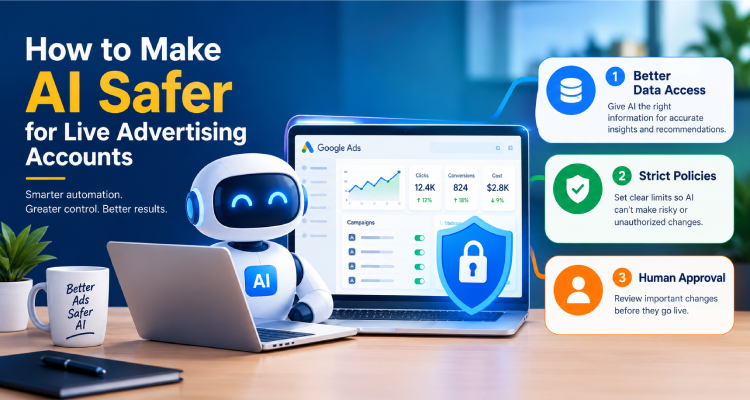
A practical approach is to use three layers of protection: better data access, strict policies and human approval.
1. Give AI Complete and Reliable Data
AI can only make useful recommendations when it has access to the information needed to understand the account.
If an AI system sees only a limited portion of campaign data, it may produce an answer that sounds convincing but is based on incomplete information.
For example, an advertiser might ask why conversion costs increased. If the AI cannot access relevant campaign history, analytics data or changes made by other users, its explanation may miss the real cause.
A strong AI advertising workflow should therefore provide access to important information such as:
- Campaign and keyword performance
- Conversion and revenue data
- Website analytics
- Account change history
- Negative keyword settings
- Auction and competitor insights
- Budget and bidding information
- Historical campaign performance
- Data from relevant advertising platforms
The goal is simple: reduce the number of unknowns available to the AI.
Better grounding doesn’t eliminate mistakes, but it gives the system a stronger foundation for analysis and recommendations.
2. Create Rules That AI Cannot Easily Bypass
Giving AI more information is only half of the solution.
The next question is: What is the AI actually allowed to change?
This should not depend entirely on a prompt.
Advertisers can create a separate policy or automation layer that establishes hard limits for account changes.
For example, a business could establish rules such as:
- Bid changes cannot exceed a specified percentage.
- Daily budgets cannot increase beyond a defined limit.
- Certain campaigns cannot be modified automatically.
- Competitor keywords require additional approval.
- Large budget changes require human confirmation.
- Sensitive account settings cannot be changed by AI.
These rules should apply regardless of who or what attempts to make the change.
That means the same protection can apply to an AI agent, an automation script or a human employee.
This separation is important because prompts are not the same as structural controls. A prompt can guide an AI, but an account-level rule can prevent an action from happening when it violates a predefined policy.
3. Keep Human Approval Before Important Changes
The final layer is human oversight.
AI can identify opportunities and prepare recommendations, but significant changes to a live advertising account should have a clear approval process.
Instead of allowing an AI agent to immediately change a campaign, create a workflow like this:
AI recommendation → policy check → human review → approval → account change
The AI first prepares the proposed action.
The policy system then checks whether the proposal follows the account’s rules.
A human reviewer can examine:
- What the AI wants to change
- Why the change was suggested
- Which campaigns are affected
- The expected impact
- Whether any policies were triggered
- The exact values before and after the change
Only after approval should the change be applied.
This approach allows marketers to benefit from AI’s speed without giving it unrestricted control over their advertising budget.
Why These Three Layers Work Together
Each layer solves a different problem.
Better data helps reduce inaccurate analysis.
Account policies help prevent unacceptable actions.
Human approval provides final accountability.
Together, they create a much safer workflow.
For example, suppose an AI system recommends increasing a campaign’s budget by 25%.
The data layer helps the AI understand campaign performance. The policy layer can identify that a 25% increase exceeds the account’s predefined limit. The recommendation can then be blocked or sent for additional review instead of being implemented automatically.
This is much safer than simply telling an AI assistant, “Don’t make large budget changes.”
Build an Audit Trail
Another important advantage of a controlled approval system is documentation.
Advertising teams often need to understand why a particular change was made weeks or months later.
A useful audit trail can record:
- The original recommendation
- The data supporting it
- The proposed change
- Policy checks
- The person who approved it
- The date and time of approval
- The final change made to the account
This creates a clear history of how AI-assisted decisions were made.
For agencies, this can also make client reporting easier because the team can demonstrate that important changes were reviewed rather than being made automatically without oversight.
Start Small and Add More Controls
Businesses don’t need to create a complicated AI governance system overnight.
A practical starting point is to identify the biggest risk in the current workflow.
If the AI lacks important information, improve the data connection first.
If AI already has permission to make changes, introduce account-level limits.
If policies are already in place, create a formal review and approval process.
The important thing is to build safeguards gradually and consistently.
The Future of AI-Powered PPC
AI will likely play a larger role in advertising management as platforms introduce more automated and agent-based capabilities.
The objective shouldn’t be to choose between complete automation and no automation.
Instead, advertisers can build systems where AI is powerful but controlled.
The safest approach is to make sure the AI:
- Has access to the right information.
- Operates within clearly defined limits.
- Requires human approval for important actions.
AI can bring speed and scale to PPC management, but businesses still need control over where and how that technology operates.
The goal is not to eliminate automation. It is to make automation predictable, accountable and easier to manage.